
Business
From Alhassan Dantata To Aliko Dangote

28 October 2026 | 2 min read
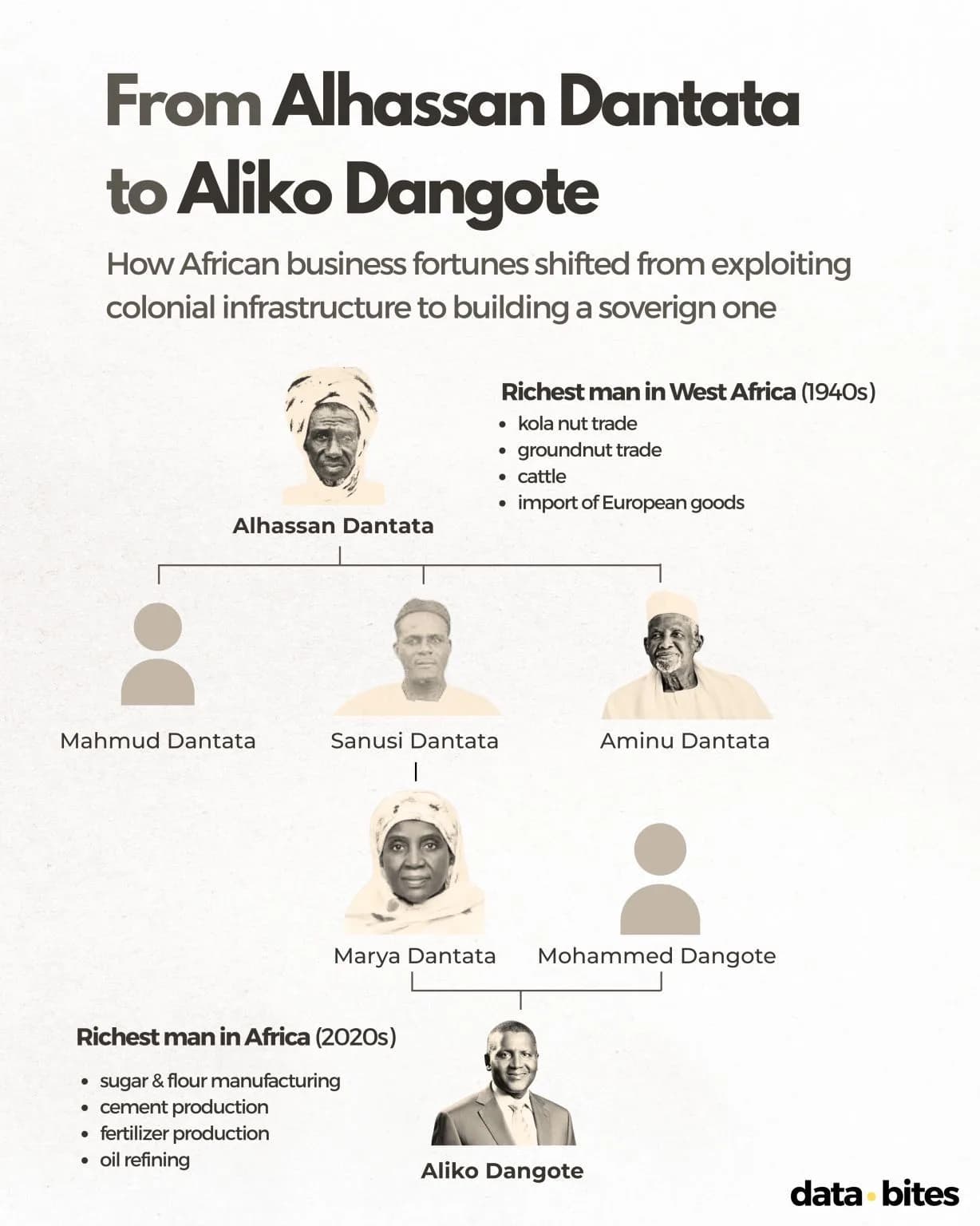
How African business fortunes shifted from exploiting colonial infrastructure to building a sovereign one
Kola nut was one of West Africa’s biggest trades for centuries. From the forests of Ghana to Northern Nigeria, Hausa merchants paved inland trade routes and made margins of up to 6,000%. In 1903, one man saw an opportunity to bypass the northern trade corridor and take the sea route from Accra to Lagos instead. That man was Alhassan Dantata.
He then built a network of groundnut buyers in Kano - right when the Royal Niger Company started trading them globally (the famous "groundnut rush").
He leveraged the newly built Lagos–Kano Railway to sell cattle to Southern markets.
He became one of the first merchants to import consumer goods directly from Europe.
By the time of his death, Alhassan Dantata was considered one of the richest men in West Africa. He saw a world that was changing and positioned himself early enough to build an empire from it.
Interestingly, Alhassan Dantata’s legacy did not vanish with him. Like him, one of his great-grandchildren watched the world reorganize itself and decided to move before others did. His name was Aliko Dangote.
Dangote began his business by importing staples that Nigeria’s growing urban population increasingly demanded: sugar, flour, and rice.
Then, he saw the vulnerability in the model and decided to move upstream. In the 1990s, he built domestic flour milling operations and one of Africa’s largest sugar refining businesses.
But he didn’t stop there. He grew Dangote Cement into Africa’s largest cement producer - by replacing imports with local manufacturing across multiple African markets.
In recent years, Dangote attempted what very few thought possible. He couldn’t make sense of his country being among the largest oil producers, yet structurally vulnerable to imported gasoline prices. So he decided to build Africa’s largest oil refinery.
Dangote Refinery is now one of the largest single-train refineries in the world, with capacity of 650,000 barrels per day.
And as global fuel markets face fresh disruptions, the refinery is increasingly positioned to supply not just Nigeria but neighbouring African markets as well.
What I like about this family story is that it sheds light on African entrepreneurial ingenuity: both men saw a changing world order and positioned themselves to build massive businesses out of it.
With a BIG DIFFERENCE, however.
Alhassan Dantata leveraged the expansion of British rule and colonial infrastructure to build a trade empire for his family.
Dangote is betting on a world where Africa can no longer afford to lack a sovereign infrastructure. So he has decided to build one.
A long-term game that is starting to pay out.
Book a session with Emmanuel Adams
Native calendar, no redirect — payment collects inline.

Comments